

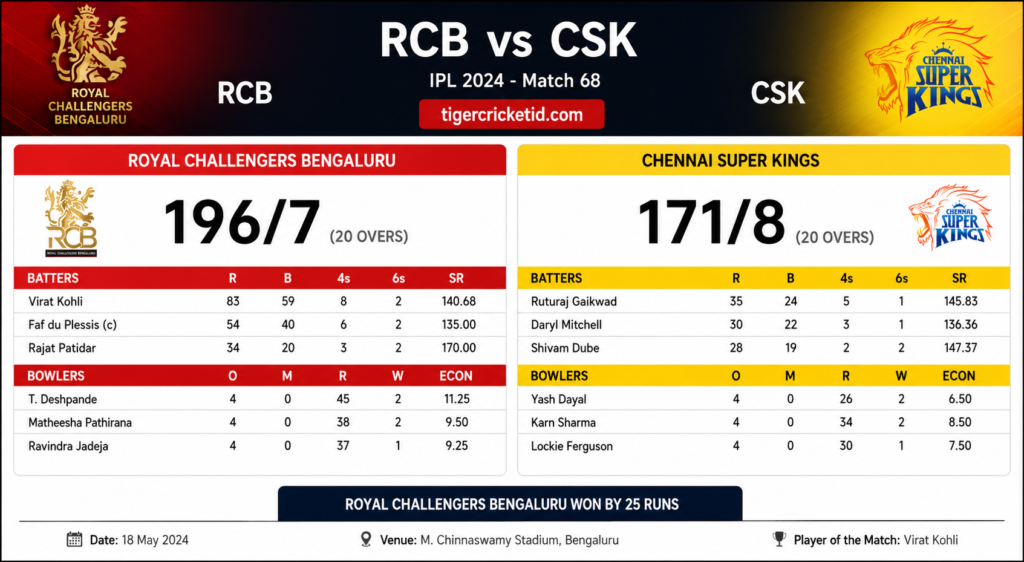
The historic rivalry between two of India’s most massive sporting fanbases hit a historic milestone at the M. Chinnaswamy Stadium in Bengaluru during Match 11 of the 2026 Indian Premier League. When these two franchises meet on a flat, high-altitude surface, historical trends dictate a heavy bombardment of boundaries, but few analysts predicted the absolute statistical outlier that unfolded. For fans and analytical trackers analyzing the structural metrics, the royal challengers bengaluru vs chennai super kings match scorecard provides an exceptional template for studying modern T20 power-hitting, death-overs acceleration, and defensive bowling variations under severe pressure.
To truly understand how this tactical narrative shifted ball by ball, we must dissect the raw numbers, the player matchups, and the key execution points that separated the winning team from the chasing pack.
Phase 1: Bengaluru’s Monumental Batting Slog
After winning the toss on a warm evening in Bengaluru, Chennai Super Kings captain Ruturaj Gaikwad made the standard tactical decision to field first, anticipating that the evening dew would make a heavy second-innings chase much more manageable. However, Royal Challengers Bengaluru had a fundamentally different plan, built entirely around aggressive optimization of the powerplay overs and a historic blitz during the final five overs of the innings.
The Foundation Layer
The opening pair consisting of Phil Salt and Virat Kohli walked out with clear tactical instructions to exploit any loose introductory lengths. While Virat Kohli fell relatively early for a crisp 28 off 18 balls undone by a clever length variation from Anshul Kamboj that was caught by Shivam Dube the foundation was already firm. Phil Salt continued his aggressive onslaught, carving out a powerful 46 off just 30 deliveries.
Following Kohli’s departure, Devdutt Padikkal joined Salt to steady the scoring rate without losing momentum. Padikkal anchored the middle phase beautifully, engineering a calculated 50 runs off 29 balls before being cleaned up by a fast, full delivery from Jamie Overton in the 15th over. At 151/3, the platform was stable, but what followed was absolute tactical devastation.
The Late-Innings Blast
The final phase of the first innings belonged entirely to the unbroken partnership of Rajat Patidar and Tim David. David, in particular, put on an absolute masterclass in clearing the boundary lines. He smashed an unbeaten 70 off just 25 deliveries, operating at a staggering strike rate of 280.00. His hitting display included 8 massive sixes, completely shattering the defensive lengths of the Chennai seam attack.
Patidar provided flawless support from the opposite end, hammering 48 not out off a mere 19 balls, including 6 clean sixes of his own. Together, they added an astonishing 97 runs in the final five overs alone, lifting the total to a colossal 250/3 at the completion of their 20 overs. For fans who monitor such metrics via their online cricket id, this specific phase represented a perfect alignment of optimal batting conditions and sheer brute force.
Technical Performance Breakdown: The First Innings
| Batsman | Dismissal Mode | Runs Scored | Balls Faced | Fours Hit | Sixes Hit | Strike Rate |
| Phil Salt | c Noor Ahmad b Shivam Dube | 46 | 30 | 3 | 2 | 153.33 |
| Virat Kohli | c Shivam Dube b Anshul Kamboj | 28 | 18 | 2 | 1 | 155.55 |
| Devdutt Padikkal | b Jamie Overton | 50 | 29 | 5 | 2 | 172.41 |
| Rajat Patidar | Not Out | 48 | 19 | 1 | 6 | 252.63 |
| Tim David | Not Out | 70 | 25 | 3 | 8 | 280.00 |
Extras: 8 (lb 4, w 3, nb 1)
Total Score: 250/3 (20.0 Overs, Run Rate: 12.50)
Phase 2: Chennai’s Truncated Run Chase
Chasing a target of 251 runs requires an optimal mix of early explosive boundaries and perfectly coordinated running between wickets. Unfortunately for Chennai, the chase ran into immediate operational trouble against a highly disciplined opening bowling spell from Jacob Duffy and veteran swing specialist Bhuvneshwar Kumar.
Top-Order Disintegration
The chase lost its primary engine within the first three overs. Captain Ruturaj Gaikwad fell on the final ball of the very first over, managing just 7 runs before offering a sharp, swinging outside edge off Jacob Duffy into the hands of Devdutt Padikkal at first slip. Young opener Ayush Mhatre followed quickly in the second over for 1 run, completely beaten by a beautiful piece of seam movement from Bhuvneshwar Kumar.
When the dangerous Sanju Samson repeated the same mistake against Duffy in the third over, falling for 9 runs via another sharp catch by Padikkal, Chennai found themselves reeling at 30/3. Shifting tactics during such high-stress moments is exactly why sports tracking platforms are so popular; users utilizing premium features from recognized online cricket id providers can see live win-probability shifts instantaneously as key wickets fall.
The Middle-Order Fightback
Despite the early collapse, Chennai refused to surrender without a fight. Sarfaraz Khan played an incredibly gritty and entertaining counter-attacking innings, compiling a swift 50 off just 25 balls, decorated with 8 boundaries and 2 sixes. His resistance was eventually cut short by the left-arm spin of Krunal Pandya, who deceived Sarfaraz into stepping out of his crease, allowing wicketkeeper Jitesh Sharma to pull off a spectacular glove-work dismissal.
[CSK Top Order: 30/3] ---> [Sarfaraz Counter-Attack: 50 (25)] ---> [Krunal Pandya Double Strike] ---> [Lower Order Resistance]
Prashant Veer (43 off 29 balls) and Jamie Overton (37 off 16 balls) kept the boundary count ticking during the middle and late overs, but the sheer weight of the 251-run target meant the required run rate climbed past 15 runs per over before the death phase even arrived. Chennai was eventually bundled out for 207 runs in 19.4 overs, falling short by 43 runs.
Analyzing the Defenses: Why Bengaluru’s Strategy Succeeded
When you look deeply at the secondary layer of the royal challengers bengaluru vs chennai super kings match scorecard, the bowling variations explain why the massive chase stalled out. While the Chennai pacers suffered heavily due to predictable lengths on a flat surface, Bengaluru’s bowling unit mixed up their speeds expertly.
Bhuvneshwar Kumar led the defensive line with absolute tactical perfection, picking up 3 wickets for 41 runs across his 4 overs. He made excellent use of wide yorkers and slow knuckleballs, preventing the lower-order Chennai hitters from extending their arms cleanly. Spinner Suyash Sharma operated as the ideal structural anchor in the middle overs, conceding a mere 21 runs in his 4 overs while picking up the crucial wicket of Jamie Overton. This level of variable control minimized the impact of the Chinnaswamy stadium’s notoriously short boundaries.
The Digital Evolution of Match Tracking for Modern Fans
As live cricket viewing shifts increasingly toward digital environments, how fans interact with deep data maps has completely changed. Watching a game purely on a television broadcast provides visual entertainment, but it lacks the contextual depth needed to truly appreciate tactical setups, shifting field positions, and live analytical fluctuations.
Why Real-Time Analytical Access Matters
To get a holistic view of modern encounters, seasoned followers rely on dedicated tracking tools that supply clean data streams without lagging or visual interruptions. Having a secure cricket id gives users an unhindered gateway to complex data hubs that display ball-by-ball movement, wagon wheels, and matchup tracking grids. This level of detailed tracking transforms a standard casual viewer into a highly informed sports researcher.
Maintaining Safety in the Sports Ecosystem
With the proliferation of digital sports networks, ensuring your personal security profile remains uncompromised is incredibly critical. Accessing dashboards through verified platforms like tiger cricket id ensures that your data transmission is protected by modern encryption algorithms. Experienced digital analysts recommend sourcing your operational profiles only from established, well-reviewed providers to prevent exposure to phishing networks or sudden service dropouts during crucial match moments.
Complete Bowling Performance Metrics
Royal Challengers Bengaluru Bowling Array
-
Jacob Duffy: 4 Overs | 0 Maidens | 58 Runs | 2 Wickets | Economy: 14.50
-
Bhuvneshwar Kumar: 4 Overs | 0 Maidens | 41 Runs | 3 Wickets | Economy: 10.25
-
Abhinandan Singh: 3.4 Overs | 0 Maidens | 30 Runs | 2 Wickets | Economy: 8.18
-
Krunal Pandya: 3 Overs | 0 Maidens | 36 Runs | 2 Wickets | Economy: 12.00
-
Suyash Sharma: 4 Overs | 0 Maidens | 21 Runs | 1 Wicket | Economy: 5.25
-
Romario Shepherd: 1 Over | 0 Maidens | 19 Runs | 0 Wickets | Economy: 19.00
Chennai Super Kings Bowling Array
-
Khaleel Ahmed: 4 Overs | 0 Maidens | 37 Runs | 0 Wickets | Economy: 9.25
-
Matt Henry: 3 Overs | 0 Maidens | 36 Runs | 0 Wickets | Economy: 12.00
-
Anshul Kamboj: 4 Overs | 0 Maidens | 52 Runs | 1 Wicket | Economy: 13.00
-
Noor Ahmad: 4 Overs | 0 Maidens | 49 Runs | 0 Wickets | Economy: 12.25
-
Jamie Overton: 3 Overs | 0 Maidens | 42 Runs | 1 Wicket | Economy: 14.00
-
Shivam Dube: 2 Overs | 0 Maidens | 30 Runs | 1 Wicket | Economy: 15.00
The Strategic Importance of Tracking Historical Data
For individuals who enjoy predictive forecasting or evaluating individual player growth trajectories across multiple tournament cycles, having access to an old or active dashboard is an absolute necessity. Tracking how specific bowlers fare against destructive lower-order finishers like Tim David under various atmospheric conditions helps fans build a robust library of analytical knowledge.
When choosing where to establish your data parameters, turning to reputable online cricket id providers gives you the peace of mind needed to focus purely on sports analytics. By choosing verified platforms, you bypass the common security pitfalls of data theft or slow server response times. Allowing your match tracking setup to run as smoothly as a perfectly timed cover drive.
Frequently Asked Questions
What was the turning point in the Royal Challengers Bengaluru vs Chennai Super Kings match scorecard?
The definitive turning point occurred during the final 5 overs of Bengaluru’s innings, where Tim David and Rajat Patidar systematically dismantled the Chennai death-bowling execution. They added 97 runs during this brief stretch, propelling the score from a competitive 153 to an unchaseable 250. This late-stage explosion completely altered the mathematical requirements for Chennai’s batting order.
How can I securely monitor live cricket statistics and analytics without broadcast delays?
To bypass the common transmission delays inherent in standard satellite broadcasts, you can establish a secure analytical profile using a tiger cricket id. This allows you to log into dedicated, low-latency data feeds that process raw numerical match points straight from ground-level data centers. Keeping your calculations perfectly synchronized with the field of play.
Why is it critical to get data credentials only from verified digital sports entities?
Acquiring your credentials from verified providers ensures your personal data passes through authenticated secure socket layer networks. Unofficial or unverified sources frequently expose users to persistent connectivity drops. Tracking cookies, and unsecured payment frameworks, which can completely disrupt your analytical tracking experience during major tournament cycles.